
Research
Robot intelligence for physical systems that work with people.
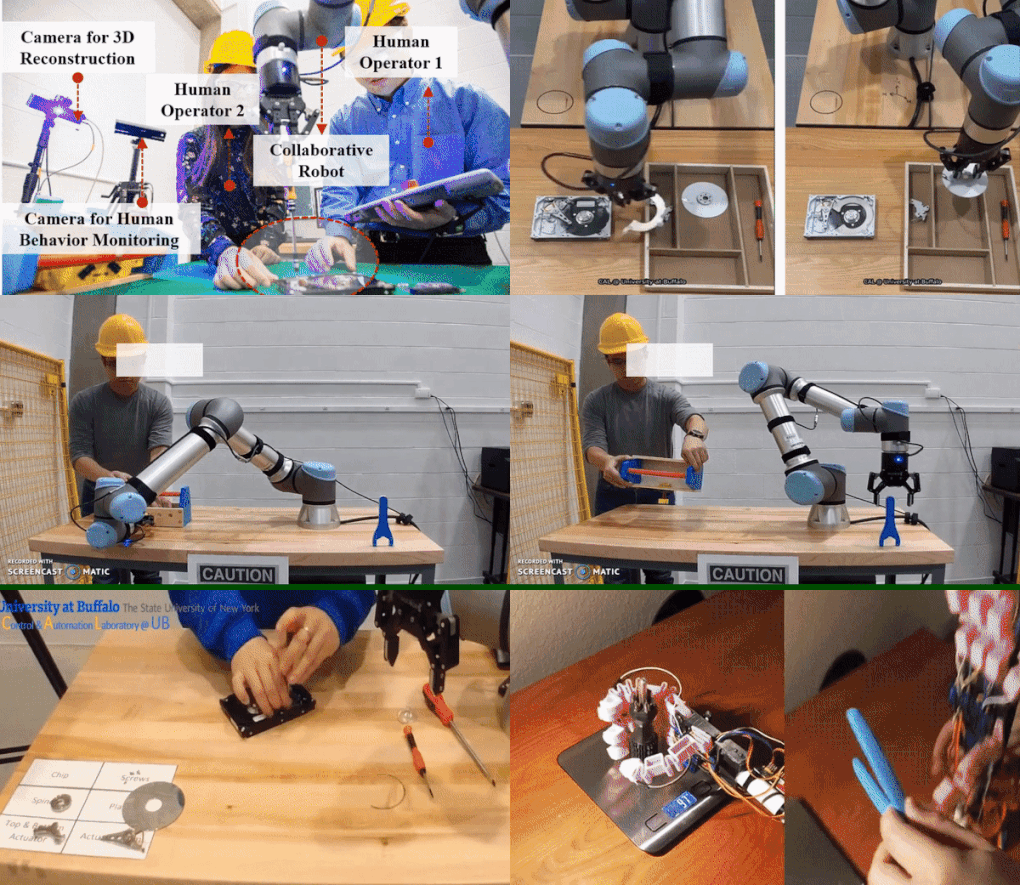
The Control and Robotics Lab develops planning, control, learning, and prediction methods for robots operating in complex real-world environments. Dr. Zheng’s research spans five connected areas, with a primary focus on human-robot collaboration for disassembly, recycling, and remanufacturing.
Ongoing research
Current projects 11
Human-Robot Collaboration for Disassembly & Remanufacturing 6
Robots that inspect, disassemble, sort, and recover components from end-of-use electronics and other products, working safely alongside people to make remanufacturing and recycling economically viable.
BRITE Pivot: Deep Robotic EV Battery Repair: An LLM-Powered Task-Motion-Manipulation Planning Framework
Principal Investigator
NRI/Collaborative Research: Robotic Disassembly of High-Precision Electronics
Principal Investigator
FW-HTF-RL: Collaborative Research: The Future of Remanufacturing: Human-Robot Collaboration for Disassembly of End-of-Use Products
Principal Investigator
Improving Recycling Efficiency of Portable Electronics by Automating Battery Disassembly
Site PI (Texas A&M)
Transforming Electronics Remanufacturing: Synergizing AI, Robotics, and Human Expertise for Greater Flexibility – TAMU
Principal Investigator
Automated Gallium Recovery From End-of-Life Electronic Waste
Co-Principal Investigator
Learning-Based Control & Autonomous Systems 1
Control and learning methods that let robots, manufacturing systems, and connected vehicles act reliably under uncertainty, from single-manipulator autonomy to multi-agent coordination.
CAREER: Facilitating Autonomy of Robots Through Learning-Based Control
Principal Investigator
Assistive & Human-Centered Robotics 1
Robotic systems designed to work directly with and for people, supporting mobility, rehabilitation, eldercare, and public health response.
BRACE: Balance-Assistive Multimodal AI-based Robotic Arm for Fall Prevention in Cognitive Eldercare – TAMU
Co-Principal Investigator
Agricultural & Bioproduction Robotics 2
Automation and robotic systems for agricultural production and bio-based material processing, including robotic harvesting, insect farming, and larval bioremediation.
NIFA: Collaborative Research: ARMOR-Harvest: Aerial Robotic Morphing for Occlusion Resilient Apple Harvesting
Co-Principal Investigator
Bioremediation of Extreme Environments: Next-Generation Automation of Black Soldier Fly Larval Production via Spectroscopy, Robotics, and Artificial Intelligence for Bioremediation of Contaminated Soils
Co-Principal Investigator
Autonomous Science & Materials Discovery 1
Self-driving robotic laboratories that integrate automation and artificial intelligence to accelerate the discovery, synthesis, and testing of new materials.
ARM-MIP: Autonomous Robotic Metallurgist Materials Innovation Platform
Co-Principal Investigator
Past research
Completed projects 9
Human-Robot Collaboration for Disassembly & Remanufacturing 2
FW-HTF-P: Human-Robot Collaboration in Disassembly for Future Remanufacturing
Principal Investigator
Towards Greater Sustainability and Autonomy: Human-Robot Collaboration for Disassembly in Future Manufacturing
Principal Investigator
Learning-Based Control & Autonomous Systems 3
Collaborative Research: Road Information Discovery through Privacy-Preserved Collaborative Estimation in Connected Vehicles
Principal Investigator
A Scalable and Customizable Framework for Multi-Agent Collaboration in Smart Manufacturing
Principal Investigator
Smart 2D Material Synthesis: Data and Knowledge Driven MoS2 Growth, Experimental Design, Modeling, and Control
Principal Investigator
Assistive & Human-Centered Robotics 2
Collaborative Research: A Holistic Human-in-the-Loop-Framework for Optimizing A Personalized Prosthetic Arm
Former Principal Investigator
Robotic Systems for Future Pandemics
Co-Principal Investigator
Agricultural & Bioproduction Robotics 2
SHaRE: Shared Robotic Ecosystem for Smart and Collaborative Agriculture
Co-Principal Investigator
Integrating AI and Robotics in Insect Farming (AIR-INF): An Intelligent Robotic System for Larval Monitoring, Feeding, and Harvesting
Principal Investigator
Get involved
Interested in joining this research?
We welcome motivated students and researchers across our research areas: disassembly and remanufacturing, learning-based control, assistive robotics, agricultural automation, and autonomous materials discovery.